
Being a good person, or at least becoming a better person, became part of my Stoic journey because it was one of the only three things that were under my complete control. Forget about trying to change other people to become good. You can become a role model or instruct and persuade other people to be good, but it is ultimately not within your control as to whether someone is good or bad, or behaving well or poorly. As Marcus Aurelius advised: teach them, or learn to bear them.
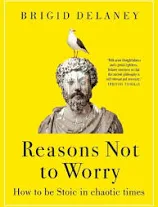
Brigid Delaney’s book is subtitled How to be Stoic in Chaotic Times. Stoic philosophy has a long history going all the way back to ancient Rome and of course, as she points out, life was pretty chaotic then too. But we have our own particular challenges at this rather dark phase of 21st century life – social media, misinformation, the use of AI all spring to mind. She set out to write a practical guide to applying Stoic philosophy to our lives, and I think she’s done it very well.
The ‘control test’, above all, is a very useful tool. It’s come down to us from the philosopher Epictetus who, nearly 2,000 years ago, asked ‘what can we directly control in our lives?’ Not much, it seems. Stoics would say that we control only our character, our reactions (and some of our actions though we cannot control outcomes) and the way we treat people. Three things! So don’t worry about the rest. I have been fretting a lot recently. Toxic politics, Gaza, the wars in Ukraine and Iran, the climate; the health worries of family members, some sticky issues with friends; weeds in the garden, stalled progress on my book, not enough exercise. Stoic advice would be: concentrate on what you can control. Get weeding, writing, walking. Inform myself judiciously (no doom scrolling). I can also donate, volunteer, participate and try be a useful community member. I can agitate for change. But my worrying doesn’t fix or solve anything, and just makes me feel awful.
This was the right book at the right time for me.
 How ludicrous and outlandish is astonishment at anything that happens in life!
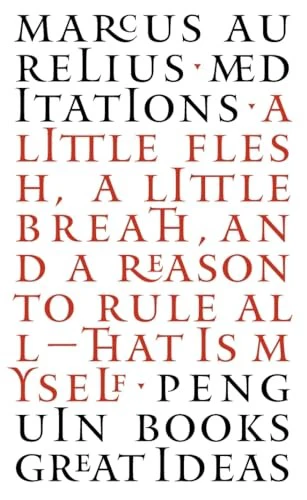
The right book at the right time is a wonderful thing. In 1991 I decided to travel far, far away from Castlemaine, Victoria, Australia, to spread my wings and try to get over a broken heart. New skies, new people, new challenges. I thought that the end of March would be Spring in Quebec. It was, but not as we know it. There was still melting snow on the ground. Though to the folks of Montreal it was positively balmy, to me it was very, very cold. My friend David was a marvellous host, but he was an actor, and busy with his work so I did a lot of solo wandering around Montreal and Quebec City, and what with the cold, the sense of dislocation and loneliness plus heartache, I was occasionally pretty miserable. One day, in an English-language bookshop, I found a Penguin Classics edition of Marcus Aurelius’ Meditations; I bought it and Marcus became a valued travelling companion and teacher. I liked to think that this man, all those centuries ago, was also simply a human being who struggled with himself too. Meditations isn’t a manifesto or a sermon, it’s just what he wrote in his private journal. Often just a few sentences on what he had learned along his way through life. There was nothing flashy, though it was often beautifully expressed. There is no ‘Secret’ (remember those best sellers full of promises?) to success, happiness, endless bliss. Who would have known that philosophy could be so sensible?
Delany’s book was my introduction to Stoicism too … I even followed her example of signing up for and completing Stoicism Week online. It makes the best sense, and I lightened up no end! Who knew indeed! Thank you Susan for this reminder of those few things we do have control over … especially how we treat one another. Which makes Charles Kingsley, in The Water Babies which was read to me when I was small, my first exposure with Mrs Do-as-you-would-be-done-by!
I might try Stoicism online too!