
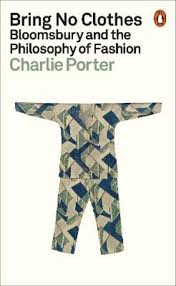
 Charlie Porter begins this book in 1920, with Virginia Woolf writing to T.S. Eliot, confirming his invitation to stay at her home, Monk’s House, in rural Sussex.
The letter concludes: ‘Please bring no clothes: we live in a state of the greatest simplicity.’
‘Bring no clothes’, in this context, doesn’t mean there’s to be a nudist getaway; she’s saying that there’s no need for fancy or formal clothes, wear whatever you like. Essentially, ‘come as you are’. I hadn’t realised what a revolutionary attitude this was, what a contrast to the rigid sartorial expectations of ‘polite society’ (the middle- and upper-classes) which ‘cemented hierarchies of class, power and gender’ through clothing. Though the women’s fashions of the 1920’s were a far cry from the corseted, trussed-up, restrictive dresses of the Edwardian era – when Virginia Woolf and Vanessa Bell grew up – there were still so many rules. You wore certain clothes in the house, and different clothes to go out. There were hats and gloves and stockings and shoes with heels. You changed out of your day clothes; you ‘dressed for dinner’ in more revealing dresses if you were a woman, and an evening suit if you were a man. You were attired for your role. The Bloomsbury group, a ‘loose collective of artists, writers and thinkers’ were more interested in the person than the role, and that was a definite philosophy of fashion.
According to Porter, it was a philosophy that said,
We are no longer living by those rules. We refuse them, we reject them, we are pushing for something new. If we were to accept Woolf’s invitation, we could ‘bring no clothes’ to our own lives, breaking from preconceptions to forge new ways of being’ .
Porter examines first the deliberate clothing choices of sisters Virginia Woolf and Vanessa Bell. Looser, more comfortable dresses, often home-made and slapdash (Vanessa was quite fond of safety pins as fastenings); flowing fabrics, shawls; daring colours (Virginia had orange woollen stockings). I hadn’t known that George Duckworth, the step-brother who sexually abused the sisters, insisted on making Vanessa his society companion, clothing her in elegant evening gowns, buying her jewellery, fans and handkerchiefs and all the feminine extras he decided she needed. He prevented her from studying and making art; she was a plaything. In later years, she remembered one dress in particular, transparent black over white, with silver sequins.
‘…though I felt all the thrill of putting on such a frock, still I came to dread the sight of it, so miserable were the many evenings I spent covered in the filmy black and white and sparkling sequins.’
What a relief it must have been when the sisters escaped Duckworth. No more abuse, and no more corsets.
Porter also takes us through the wardrobes of Lady Ottoline Morrell, the economist John Maynard Keynes, artist Duncan Grant (who liked to wear as little as possible) and novelist E.M. Forster. I found Forster’s story very moving. A closeted gay man, he covered himself in the uniform of suit, shirt and tie for most of his life. ‘Trapped in tailoring,’ as Porter puts it, his clothing choices ‘tell us much about repressed queer lives in the first half of the 20th century’. It was only in his late 30’s, while in Egypt during WWI, that he found sexual love with a young tram conductor. And there is photograph of him, taken from Forster’s album. Apparently, it is the first photograph where he is smiling. And his shirt is unbuttoned.
Near the end of his long life, Forster wrote:
…when I am nearly 85 how annoyed I am with Society for wasting my time by making homosexuality illegal. The subterfuges, the self-consciousness might have been avoided.
Porter is a queer man, too. He writes,
In the UK today, it’s easier for a lanky, soft, awkard queer human such as Forster to find a place for themselves. I am one. I was born in 1973, three years after Forster died. I remember the pain I felt as a young kid, of imagining my future life unrealized. It felt tight, like the bitter tightness in Forster’s words. It felt like my life was likely to be wasted.
I could write more, but instead I’ll encourage you to read ‘Bring No Clothes’. It’s intimate, warm, engaging and makes you think again about what you put on your body, and why.
Wow, this book sounds amazing. Off to look it up somewhere.