 Dad died in February 1999. A few years after his death, a retrospective exhibition of his work was held at the National Gallery of Victoria. Almost all of his paintings were displayed in the exhibition. He was ‘speaking’ to us in his paintings. He was also speaking to us in grey font printed directly onto the wall: ‘What I paint is what interests me most, that is, people; the human condition.’
A pang of anger hit me as I read those words. I wanted to say, ‘You might have painted pictures of your four daughters but what would you know of the human condition of any one of us?’
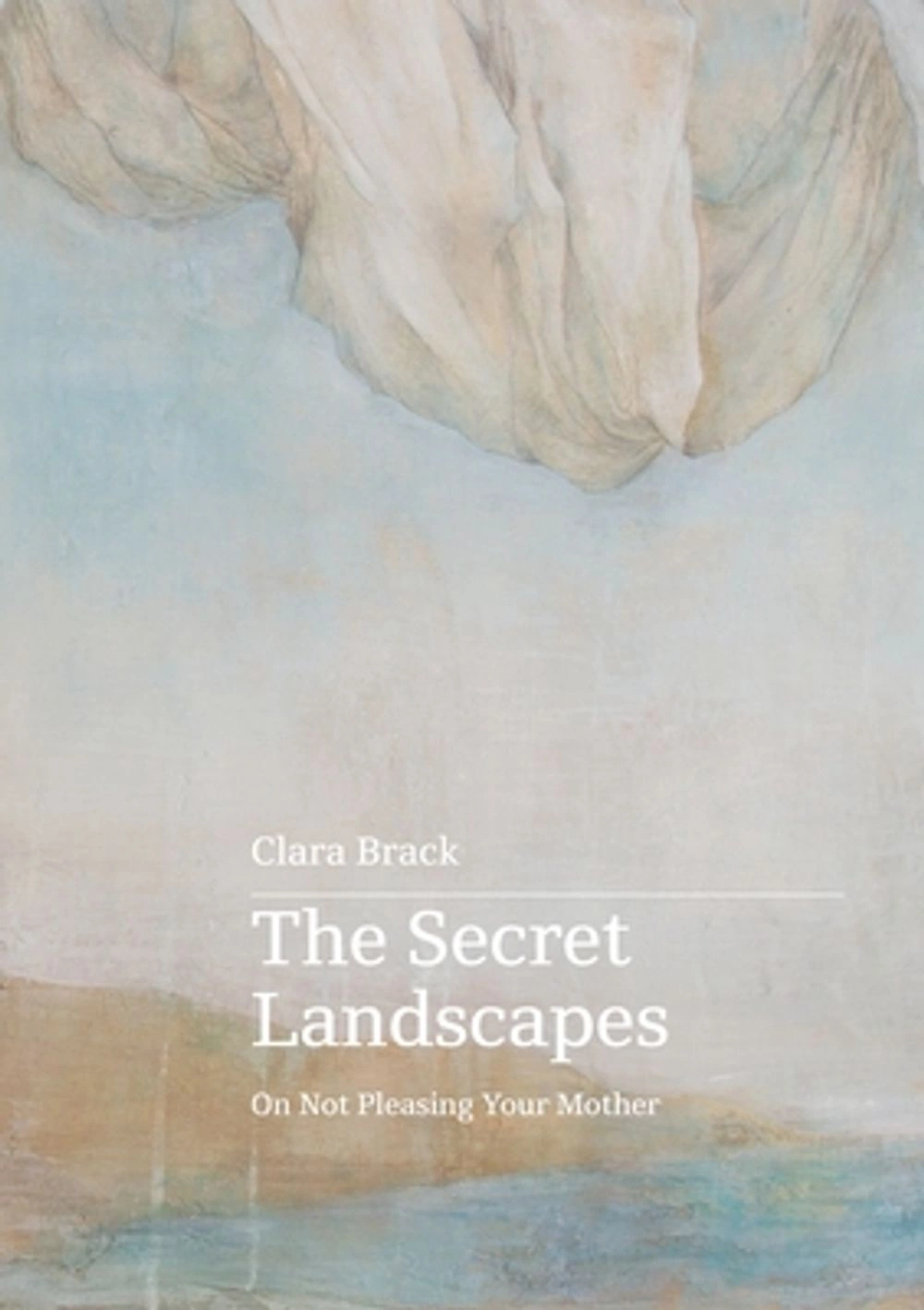
Clara Brack has been writing this moving and sad book for the past 20 years, and I think I can understand why it took so long. Coming to terms with who your parents were – and weren’t – can be a hard and slow road.
Brack is the oldest daughter of artists John Brack and Helen Maudsley. Her father was famous – even if you don’t know much about Australian art, you might recognise his painting Collins St 5pm. You might even have studied it at school. Her mother took her role as ‘artist’s wife’ and all that entailed of supporting him and assisting with his career, very seriously. She also had what amounted to sole responsibility for the running of a house and caring for their four daughters, so she painted in what little time was available to her. No wonder her work is less well known.
The family life Clara experienced was nothing like the happy riot of domesticity described in this commentary on his ‘Four Daughters’ series of prints. John Brack comes out of this book as a difficult, troubled and driven man. He came from a working class family, and he knew about poverty and lack of opportunity; though he was awarded a scholarship to a private school, the family didn’t have enough money for the uniform. His mother passionately wished him to ‘better himself’ – perhaps enter one of the professions – but he chose to become an artist. He became estranged from both his parents, and in turn, he was a distant and critical father.
I was fearful of his criticism, but I also wished to protect him. Deeply within him one sensed a vulnerability, a fragility, a void. It felt to me that a sense of dark precariousness hung over the family, exuding an ominousness that could never be referred to. I was not aware of it until I left home.
As Clara describes her childhood, while her father was either painting or teaching, her mother was busy fulfilling her various roles of artist’s wife, housewife, mother and artist. There was always a sense of distance – perhaps it was her mother’s ‘establishment’ background (her father was a prominent psychiatrist, and president of the Melbourne Club), or perhaps it was simply the era. One of her maxims was ‘private is private’, and Clara wrote this book with the knowledge that her mother would find the revelations – about John Brack’s alcoholism and eventual slide into dementia, the unhappy family life, Clara’s own childhood trauma – difficult. She held off publication of the book for many years, but as her mother is now close to 100 and suffering cognitive decline, The Secret Landscapes can’t effect her.
The Secret Landscapes is not only a mixture of memoir and biography, but a work of imagination. Clara has given her parents another chance. She’s invented a therapist for her father so that he is able to give up the booze, keep painting and avoid dementia. She could not imagine her mother seeing a therapist, so for her she’s devised a character who becomes a friend and confidante. Both conversations lead gradually not to some kind of facile fictional ‘healing’, but to a greater understanding of their lives, and hers. There is much painful truth-telling here, but by the time I finished, I understood this book as a gift of love and generosity. And courage.
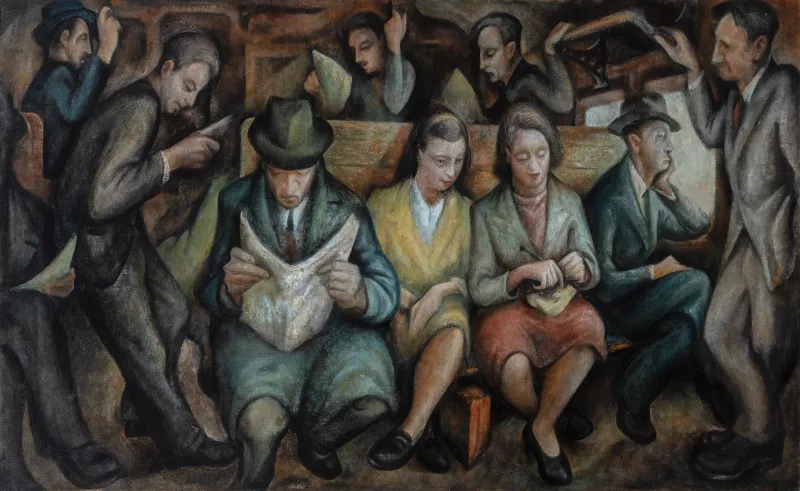 ‘Second Class’, Douglas Green, 1947.
This painting is in the collection of the Warrnambool Art Gallery but for most of my childhood it hung on the wall of our house. My father painted it, and there is a link to Clara Brack’s book. John Brack was the model for the man looking out of the window on the far right, and Helen Maudsley for the woman in yellow in the centre of the painting. My father knew them when they were all art students; in fact, Dad shared a studio with John Brack at one time. Apparently, the three of them spent a day on the relatively quiet Sandringham train line; John and Helen posing, and Dad sketching and drawing. A little bit of art history!
That sounds so fascinating, Sue, and what a wonderful painting of your father’s.
Beautiful review Susan. The years of working on this is a testament to Clara and her determination to better understand her parents and make peace with what were lifelong challenging relationships. A