
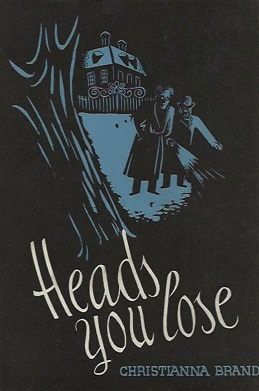
 Christianna Brand (1907-1988) published steadily for most of her writing life, from her debut novel Death in High Heels in 1941 to her last short stories for detective magazines like Ellery Queen’s in the early 1980’s. Her output spanned detective fiction – including 7 in the Inspector Cockrill series – mysteries, romances and children’s books. She was a prolific short story writer for magazines, anthologies and collections; she published under her own and five different pen names. Nothing if not versatile! But she seems to be mostly forgotten today, except for her Nurse Matilda books, which served as the source material for Emma Thompson’s Nanny McPhee.
Heads You Lose (1941) was her first Inspector Cockrill book. It’s classic British crime. English house party, country estate, a cast of family, friends and servants, heavy snow and two particularly gruesome murders. As you might expect from the punning title, they are decapitations.
Stephen Pendock is the handsome, middle-aged squire of Pigeonsford, and an attentive, much-liked host. His house guests are an old friend, Lady Hart, with her twin granddaughters Francesca and Venetia as well as Henry Gold (Venetia’s husband) and another young man, now in the army, called James Nicholl. He’s been a frequent visitor to the neighbourhood since his youth. A village neighbour, Grace Morland, moons around the house yearning after Pendock, and her niece, actress Pippi Le May, pops up from London and visits the big house as well. I counted at least nine servants. Trotty, Miss Morland’s maid, and Bunsen, Pendock’s butler, are the most prominent.
Brand clearly enjoyed the puzzle aspect of the murder story. On the face of it, both murders seem impossible. Several perpetrators are suggested; a possible scenario is proposed, investigated and discarded before the murderer is found. On this first outing, Inspector Cockrill seems undeveloped as a character, and it is the upper-class and privileged of Pigeonford who are most fully drawn.
Which could be a bit of a hitch for current day readers. The twins, Francesca and Venetia, are a couple of very spoiled young ladies whose Nanny should have put in the naughty corner more often. I think they are meant to be charming. But, for example, their insistence that their pampered dog be allowed into the inquest seems simply rude and their tangled emotions are sheer self-indulgence. I kept thinking, for God’s sake, people have been killed here. And there’s a war on!
In comparison to the Patricia Wentworth novels, these two books were more individual and better written – but less satisfactory. That’s because tone is wildly uneven; I kept being jerked out of the narrative by my strong reactions to Brand’s treatment of several of the characters. They are the outsiders, of course. The spinster Miss Morland is unmercifully pilloried for her failure to attract the man she loves; Pippi le May’s actressy glamour is cheap and not quite clean; we’re never allowed to forget that Henry Gold, Venetia’s husband, is a Jew and ‘not one of us’; the servants are inferiors to be patronised or laughed at. I suppose if you are an insider, it’s OK. If not – it’s cruel.
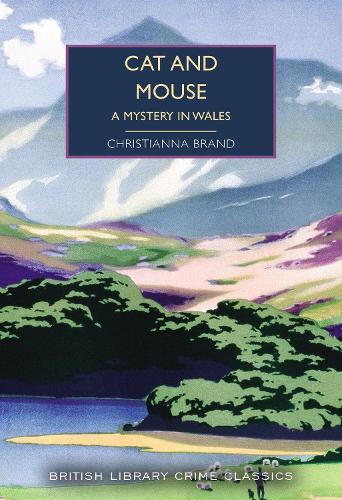 I found the same issue – cruelty – with Cat and Mouse.
It is a claustrophobic psychological thriller set in rural Wales. Journalist Tinka Jones arrives to visit one of her magazine’s advice-column correspondents – known only as ‘Amista’ – a young Welsh girl. Letter after letter, like a serial story, Amista has told of her life on an isolated hilltop with her guardian, Carlyon, and his two servants. She details her daily life, the beautiful Welsh hills and valleys, her growing love for Carlyon, their sudden romance, his proposal of marriage, her great happiness… When the letters stop, Tinka is curious.
She finds a lonely and gloomy house, a Heathcliff-like owner, two servants and the news that no-one has ever heard of Amista. But if she doesn’t exist, how did she know so much about the house, the staff and Mr Carlyon? Why is the policeman, Mr Chucky (yes, really) keeping watch? When she is forced to stay the night, Tinka realises that there is another inhabitant. It is Mrs Carlyon. Is she Amista? But the young woman has been in a car accident and is now terribly scarred, disabled, unable to speak. A dramatic scenario for a tense, creepy thriller. but…
…it was just so disturbing to read Brand’s descriptions of disfigurement. She uses the language of disgust; ‘monstrous ruin’, ‘muffled animal bleatings’, ‘an unrecognisable mask of a woman’, ‘incoherent gobblings and gruntings’, ‘a poor, shuffling, bowed creature’ with ‘pig-like eyes’. Tinka tries to act towards Mrs Carlyon with compassion but because the revulsion is so visceral, it’s tough reading. With other characters, too, there’s the same disdain for the lonely spinster, the vulgar and cheerful nurse, the uneducated Welsh servant.
I read crime novels to relax (yes, I know; it’s not quite right, is it?) a more conventional writer might be a better bet. I’m on to Ngaio Marsh next.