
 She pulls me towards her and says, “Irv, don’t forget I’ve been living in pain and misery for ten months now. I’ve said to you again and again that I cannot bear the thought of living like this any longer: I welcome death, I welcome being free of pain and nausea and this chemo brain and this continual fatigue and this feeling awful. Please understand me: trust me – I’m certain that if you had lived all these months in my condition you’d feel the same way. I’m devastated at the thought of leaving you. But, Irv, it’s time. Please, you’ve got to let me go.”
This is not the first time I have heard these words. But it is perhaps the first time I let them penetrate my mind. Perhaps for the first time, I truly grasp that if I had gone through the last ten months of what Marilyn has experienced, I would be feeling precisely the same way! If I lived with that much anguish, I’d be welcoming death, just like Marilyn.
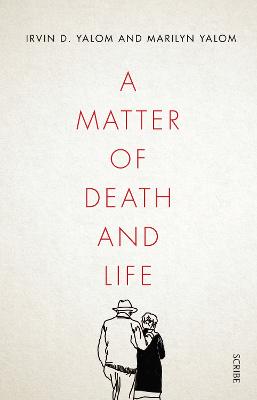
I was alerted to this book by Kate Constable. Irvin and Marilyn Yalom, faced with her diagnosis of terminal cancer, decide to write – together – the story of her dying and death. After she dies, Irv writes on, describing his grief and his struggle to continue without the companion and love of his life.
My mother-in-law died last year after a couple of years battling a long illness, leaving my father-in-law a widower. They met as teenagers – like the Yaloms – and he was her friend for 72 years, her husband for 65. They were a close and loving couple, and I feel for him so much; it must be like losing a limb, or half your heart. So I was interested to read Irvin Yalom’s reflections on his somewhat similar experience. He and his wife Marilyn were married for 65 years, too.
I knew of Irvin Yalom – I’d seen his books – and was aware of his huge influence in the world of psychiatry. I didn’t realise that his wife, Marilyn, was also a distinguished academic and writer as well. While Marilyn suffers through her appointments for chemo and infusions and tests, Irv become increasingly aware of his own decline; these two intelligent and remarkable people face what we all do (if we are lucky), whether we are remarkable or bog standard ordinary – old age and the imminence of death.
I am in two minds about the book. On the one hand, it was a candid and very moving account of love and suffering and loss. There are many poignant moments and even I, hard-hearted monster that I am, had to blink away the tears from time to time. Of course, I was drawn to reflecting on what’s to come for me and my husband, as well as my father-in-law approaching the first anniversary of his wife’s death, and my own mother’s experience of losing Dad, and her 6 years of life without him.
And. Yet. I couldn’t fully warm to A Matter of Death and Life. The Yaloms were a privileged couple, wealthy and worldly, well-travelled, highly educated, famous and successful, so that while some of their experiences were universal, many of them were not. Money cushions death as well as life; knowing what I know about the American health care system, it’s clear that the Yaloms were among the few who can afford to pull out all the stops. Plus, with a loving family, a large group of friends and colleagues, even a devoted housekeeper, Irv had no shortage of people to shoulder the burdens of care.
And with all his years as a psychiatrist, counselling others with a deep understanding of the human condition, it seems that at certain vital times his need for Marilyn trumped his love. The excerpt above demonstrates what I’m getting at. Irv hadn’t been able to really feel into Marilyn’s experience; that’s understandable, I suppose. But he also didn’t listen to her. She had to ask, repeatedly, for him to let her go.
So perhaps it is Irv I couldn’t fully warm to.
Yes, you’re right. I was surprised by Irv’s seeming selfishness at times (or perhaps he was just being brutally honest), and surprised and a little dismayed when he admitted that he’d never fully grasped the despair of his patients when they suffered similar grief. What a lucky man, to have reached the very end of his life before experiencing such depth of sorrow and loss.