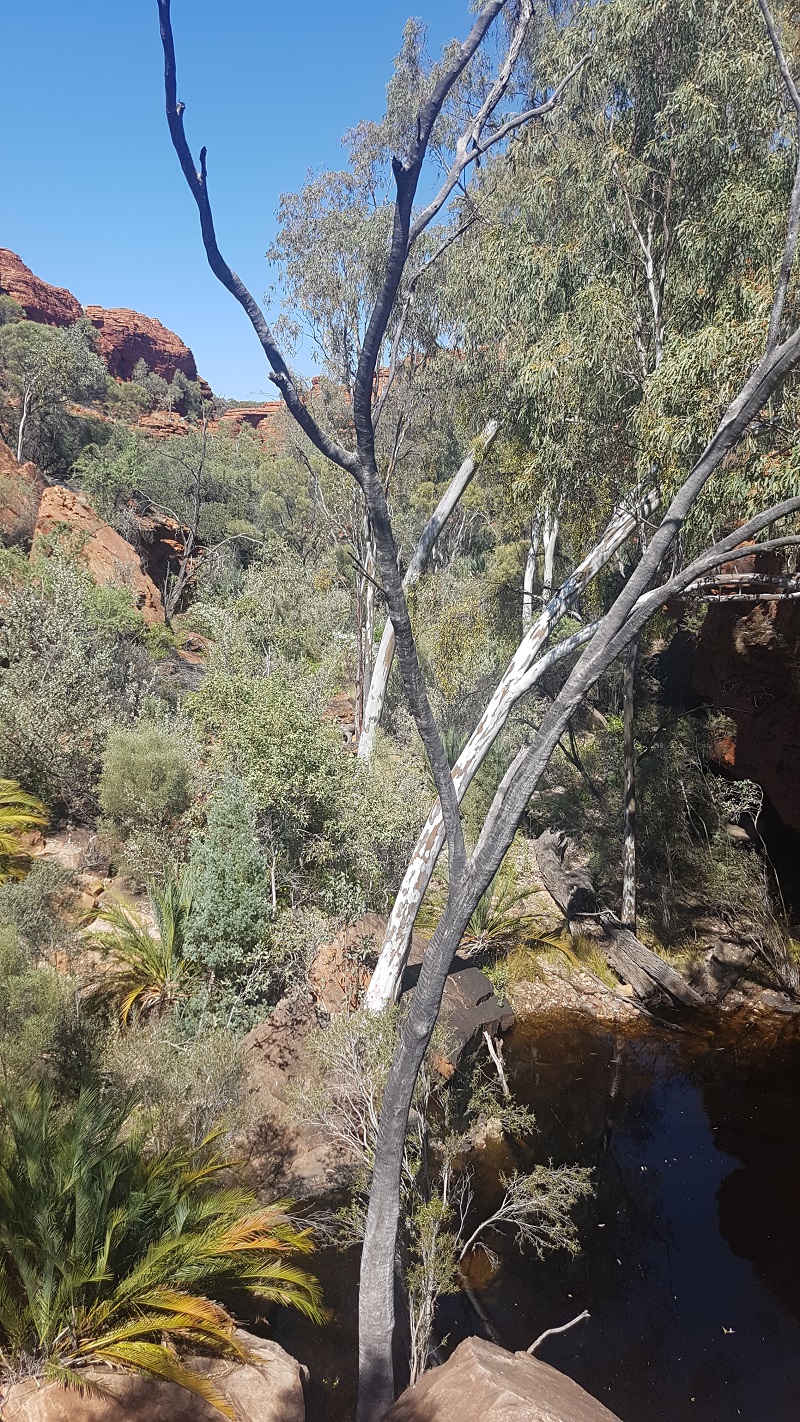
 I…lay listening to the mad, abandoned cries of flocks of pink-and-grey galahs that raved over me now and then, rolling and tumbling, revelling in their early-morning aerobatics. Some of them alighted briefly in the slender bare white arms of a solitary ghost gum that stood fifty yards from the foot of my bed. Its pale, smooth trunk gleamed pinkly in the morning sun. The ghost gum is a dancing woman in the Arrernte songs that tell the dreaming stories of the creation of this land. The tree’s graceful from was actually created by the gallantry of generations of amorous cock galahs: they would roost in it, break off the terminal shoots of its twigs with their strong parrot beaks and offer them as love-tokens to the hens, which always politely accept them, then discreetly drop them. the constant pruning causes the branches to grow in curves from their lateral shoots and gives the whole tree the fluidity of a dancer.
I have yet to get hold of Roger Deakin’s first book, Waterlog (1999), but I know that it’s a wild-swimming odyssey around Britain, and it sounds wonderful. He died of cancer shortly after finishing the manuscript of Wildwood, and it was published posthumously in 2007. So there won’t be another book like this…wandering, eccentric, obsessed, unique. He writes in his introduction:
Wildwood is a quest for the residual magic of trees and wood that still touches most of us not far beneath the surface of our daily lives… Human beings depend on trees quite as much as on rivers and the sea. Our intimate relationship with trees is physical as well as cultural and spiritual: literally an exchange of carbon dioxide for oxygen. Once inside a wood, you walk on something very like the seabed, looking up at the canopy of leaves as if it were the surface of the water, filtering the descending shafts of sunlight and dappling everything…
What a pity Roger didn’t live to write another book, about the sea.
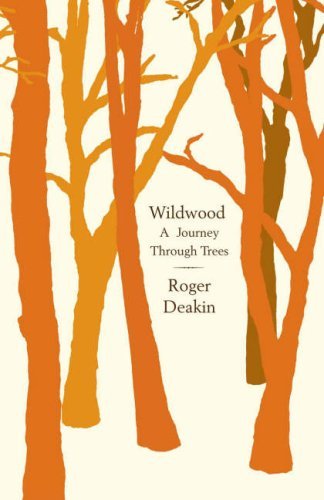 He starts with English woods around his home in rural Suffolk and moves outwards within Britain and then overseas in wandering trails of family stories, folk tales, craft and tool-making, history, memoir, environmental and ecological science, zoology, botany, literature, myth and legend, travel, art. It’s the kind of wide-ranging, wondering book I love. Wildwood had a couple of sections on British artists that didn’t interest me all that much, but after ploughing through them I was rewarded by an account of his visit to Australia. He travelled with artist John Wolseley and stayed at Wolseley’s home in the Whipstick forest near Bendigo, not so far from where I live. So while I can imagine in soft focus the European and British forests he writes about, I know the Whipstick landscape well, and that feels quite special.
I loved reading about my own country – Central Australia, the Pilliga forest in NSW, my own Central Victoria – my favourite part of Wildwood was his journey in Kazakhstan. He wanted to see the wild apple and walnut forests, and to meet the people who live and work there.
…we dip and thread our way through the fruit forest, past a solitary yurt in a wooded glade, then two or three tented settlements of simple farmsteads. Outside a very simple wooden hut, barely more than four or five packing cases, sit a little family with their horses and cattle tethered nearby. Two small girls are braiding their mother’s waist-length hair, proudly brushing it for her as it shines in the sun. Climbing a steep holloway past exposed roots of elms, apples and apricots, we come to a cottage and farmstead in the woods. Here… we are invited to lunch.
It could have been taken from Paddy Leigh Fermor’s pre-WWII adventures. And yes, yes, yes, I know that life in this ex-Soviet ‘stan’ would not have been all apples, apricots and unicorns, but oh, how delicious and paradaisical to imagine.
Not a quibble, just a thought. This genre of book – which I love – is usually written by a white Englishmen (Robert McFarlane, etc); perhaps my next search is for one by a black woman, for there surely are some, just as there are now books by Black women gardeners. As an aside, I have been listening to lots of gardening podcasts. While definitely enjoying posh Englishwomen waxing lyrical about their borders, it’s also been good to hear, for instance, about the Black Southern agrarian tradition from actual Black Southern women who spring from 8 or 9 generations of farmers and gardeners in the same ‘home place’.